TL;DR
- Fascia is the connective tissue that wraps and links your muscles, bones and organs, from just under the skin down to each muscle fibre bundle.
- Fascia therapy (often called myofascial release) uses sustained pressure, stretch and guided movement on these tissues to support more comfortable motion.
- Research reviews suggest it can help some people feel less pain and move better in the short term, but study quality is mixed and results vary.
- At ZenMotion in Singapore, fascia-focused work is one part of a session shaped by how you move, your feedback and your goal. It does not replace medical diagnosis or care.
If you have searched for fascia therapy in Singapore, you have probably seen the terms fascia, myofascial release and “tight fascia” used in very different ways. This guide explains what fascia actually is, what fascia therapy involves, what the research says, and what you can expect from a fascia-focused session at ZenMotion.
What is fascia?
Fascia is a continuous network of connective tissue made mostly of collagen, elastin and a fluid-rich ground substance. The Fascia Research Society describes it as a sheath, sheet or other dissectible collection of connective tissue that forms beneath the skin to attach, enclose and separate muscles and internal organs.
In simple terms, there are three layers most people will hear about:
- Superficial fascia: a looser layer under the skin that contains fat and lets the skin glide over what lies beneath.
- Deep fascia: denser sheets that wrap groups of muscles and help transfer force between them, such as the thoracolumbar fascia across the lower back.
- Muscle-level fascia: thin sheaths around each muscle, each bundle of fibres and each fibre.
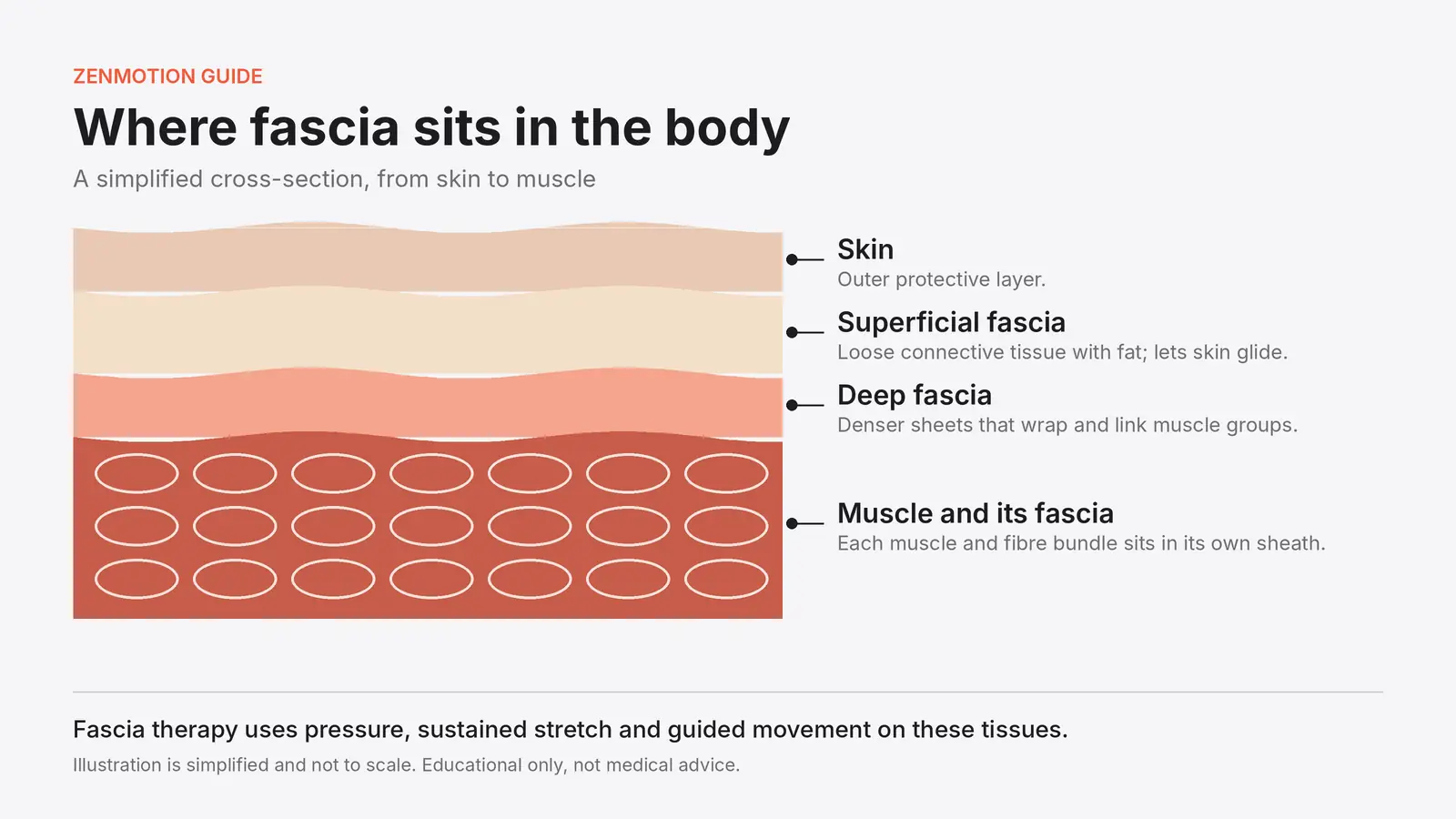
Fascia also contains many sensory nerve endings. That is one reason it is studied in relation to stiffness, body awareness and how sensitive an area feels.
What is fascia therapy?
Fascia therapy is a broad name for hands-on techniques that target fascia and the muscles it surrounds. The most common form is myofascial release: slow, sustained pressure or stretch applied to an area that feels restricted or tender, often while the person breathes slowly or moves the limb.
Related approaches include instrument-assisted soft-tissue work, foam rolling (a self-applied form of myofascial work), and movement-based soft-tissue techniques where pressure is held while a joint moves through a range. Many sports massage and manual therapy sessions blend these methods rather than using one alone.
How does fascia therapy work?
The honest answer is that the exact mechanism is still debated. Older explanations claimed that therapists physically “melt” or “break up” fascia. Current research suggests that dense fascia is very hard to deform with the hands alone, so other explanations are now considered more likely:
- Nervous system response: pressure and stretch stimulate sensory receptors, which may reduce muscle guarding and change how sensitive an area feels.
- Fluid and glide: movement and pressure may help the layers slide more easily against each other.
- Movement confidence: moving an area comfortably under guidance can make it easier to keep moving afterwards.
What does the research say about fascia therapy?
A 2015 systematic review of randomised controlled trials in the Journal of Bodywork and Movement Therapies found that myofascial release showed encouraging results for a range of conditions, while noting that many trials were small and of varying quality.
A later systematic review in Clinical Rehabilitation (2018) was more cautious. It concluded that the evidence for myofascial release is limited and that better-quality studies are needed.
The practical takeaway: fascia therapy may help some people feel looser and less sore for a period, especially as part of an active plan that includes movement and training. It should not be sold as a cure, and it is not a substitute for assessment when pain is severe, new or unexplained.
Who might consider fascia therapy?
People commonly look for fascia-focused work when they notice:
- Stiffness after long hours at a desk, driving or flying
- Tightness linked to running, lifting, cycling, golf, racquet sports or martial arts
- A heavy or restricted feeling through the hips, back, shoulders or calves
- Recovery goals during a block of hard training
If training load is the main issue, sports massage in Singapore may be the better starting point, with fascia work added where it suits.
What happens in a fascia-focused session at ZenMotion?
Sessions with Zack start with a conversation and movement checks rather than a fixed routine. Zack calls this starting point visual tensegrity body analysis: observing posture, movement, muscle tone and areas of tension. As ZenMotion explains on its manual therapy page, “It guides the session; it is not a medical diagnosis or a guaranteed root-cause test.”
From there, fascia-focused work may be combined with other techniques used in movement-focused manual therapy, such as:
- Slow, sustained myofascial pressure and stretch
- Active Release Mobilisations, where soft-tissue work is applied while you move
- Trigger-point work on sensitive or overworked areas
- Assisted stretching and simple movement re-checks
Pressure is adjusted to your feedback throughout. Before and after the work, the same movements are usually re-checked so you can feel whether anything has changed.
Is fascia therapy painful?
It should not be painful in a way that makes you tense up. Most people describe a strong, stretching or “good discomfort” sensation that eases as pressure is held. Some mild soreness for a day or two afterwards is common, similar to after a hard workout. Tell your therapist if anything feels sharp, burning or makes you hold your breath, so pressure can be changed.
When should you see a doctor instead?
Fascia therapy is not the right first step for every problem. See a doctor or physiotherapist first if you have:
- A recent injury with swelling, bruising or inability to bear weight
- Numbness, tingling or weakness that spreads or gets worse
- Pain with fever, unexplained weight loss or night pain that does not ease
- Blood clotting conditions, recent surgery, or are on blood thinners
ZenMotion supports movement and recovery. It does not diagnose injury or replace medical care, and can work alongside your medical team when suitable.
How do you book fascia therapy in Singapore?
ZenMotion is a one-to-one practice at 111 Somerset Rd, #08-04, Singapore 238164, by appointment only. Send a WhatsApp request describing what is bothering you, what you want to get back to doing and your preferred session length. Zack will reply to confirm suitability and timing.
Frequently asked questions
Is fascia therapy the same as myofascial release?
Mostly, yes. Myofascial release is the best-known type of fascia therapy. “Fascia therapy” is a wider umbrella that also includes movement-based soft-tissue work and instrument-assisted techniques.
How many fascia therapy sessions will I need?
It depends on your goal, training load and how your body responds. Some people come in for occasional recovery sessions, while others prefer a short block of sessions during a demanding training period. There is no fixed number that suits everyone.
What is the difference between fascia therapy and sports massage?
Sports massage focuses on muscles affected by training and recovery. Fascia therapy uses slower, sustained techniques aimed at the connective tissue around those muscles. In practice, many sessions combine both.
Can I do fascia release at home?
Yes. Foam rollers and massage balls are common self-applied options. Use slow, moderate pressure, avoid bony areas and the front of the neck, and stop if you feel sharp pain, numbness or tingling.
What should I wear to a fascia therapy session?
Wear comfortable, stretchy clothing you can move in, such as shorts and a fitted top, so movement checks and assisted stretches are easy to do.
Sources: Fascia Research Society, Fascia nomenclature; Ajimsha MS et al., Effectiveness of myofascial release: systematic review of randomized controlled trials, J Bodyw Mov Ther, 2015; Laimi K et al., Effectiveness of myofascial release in treatment of chronic musculoskeletal pain: a systematic review, Clin Rehabil, 2018.
This article is general information only and is not medical advice. Speak to a doctor about any new, severe or worsening symptoms.